Following Water From Molecule To Global Force
Water is chemistry, climate regulator, transport medium, economic asset and foundation of life. This page moves through the major ideas step by step, from the nature of H2O itself to the global systems that depend on it.
Element H2O
Water has a simple formula, yet it behaves in ways that make life and civilization possible.
Less than 1% of global water reserves is directly available for drinking. That is why water treatment matters so much: it allows societies to turn difficult raw water sources into water fit for human, industrial and environmental use.
The composition of water was uncovered step by step. Henry Cavendish showed that hydrogen and oxygen could combine explosively, and in 1811 Amedeo Avogadro clarified the H2O formula that defines water as we know it.
Water is remarkable because it exists on Earth as a solid, liquid and gas. It is far denser than air, which creates buoyancy, and it reaches its highest density at around 4 degrees Celsius. That is why ice floats, lakes freeze from the top, and aquatic life can survive beneath winter ice.
It is also a poor heat conductor with a strong ability to store energy. Oceans and large water bodies absorb heat in warm periods and release it in colder ones, helping moderate the climate.
As a universal solvent and transport medium, water carries salts, nutrients and ions through soils, plants and ecosystems. Without this movement, the natural cycles of nitrogen, phosphorus and life itself would not function.
Water Blue Gold
Our water is a food and a means of production. It is both a source of energy and a world of experience. Water is a unique medium, whose limited availability and increasing value mankind is becoming progressively more aware of.
In the next few decades there will be a significant change in the global water resources in many parts of the world. According to the 'Intergovernmental Panel on Climate Change' drought areas will expand further, heavy rainfalls will increase and glaciers and snow areas will get smaller. 'Freshwater stress' has dramatic consequences at the local level.
'We are entering an era of aggravated water shortage where easy access to 'blue water' is coming to an end in many parts of the world. Increasing water pollution, more and more depleted rivers, over-used groundwater, the threat to water consumption from salination and from water ecosystems slipping below the critical minimum indicate a turning point for 'blue water resources', says Prof. Malin Falkenmark from the Stockholm International Water Institute.
The hitherto inadequate, or poor, supply of hygienic and toxicologically harmless drinking water to a large proportion of the world's population, and the availability of sufficient process water, represent one of the most serious challenges to mankind over the next few decades.
Soon, the value of water will exceed that of crude oil.
Global Water Reserves
Water is the fundamental ingredient for life on Earth. Looking at our Earth from space, with its vast and deep ocean, it appears as though there is an abundance of water for our use. However, only a small portion of Earth’s water is accessible for our needs. How much fresh water exists and where it is stored affects us all.
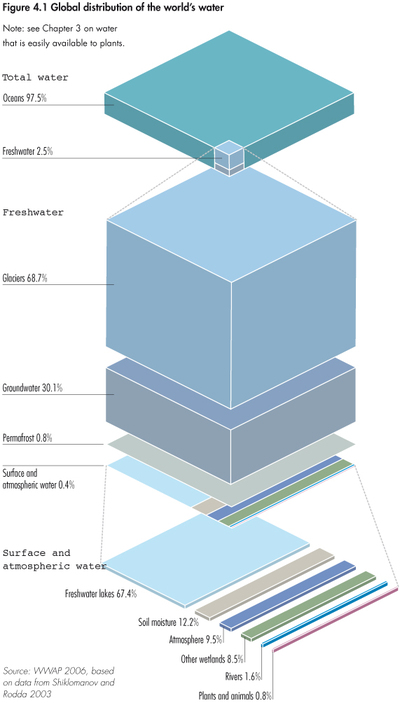
Around 97 % of the Earth’s water resources are salt water. A significant proportion of fresh water reserves are trapped in the polar ice caps and glaciers and only 0.649% of all water resources can be used for drinking.
According to UNO estimates, the world’s population is set to increase from approximately 7.2 billion today to 9.6 billion by 2050. Due to the increasing average per capita consumption of water, currently 625m³ per annum, water consumption will also grow disproportionately.
Globally, more than one billion people have no access to clean drinking water. In 25 years up to 6 billion people will be experiencing water shortages because of poor hygiene. Even Europe’s natural water resources are being put under ever-increasing stress. Water stress arises when the amount of water used exceeds availability. In Austria, only 3% of the total renewable water supply is extracted annually – we therefore live in a veritable water paradise. By contrast, Bulgaria and Belgium, for example, suffer from water stress because they consume 55% and 41% respectively per annum of the renewable water supply.
Water Cycle
The Water Cycle
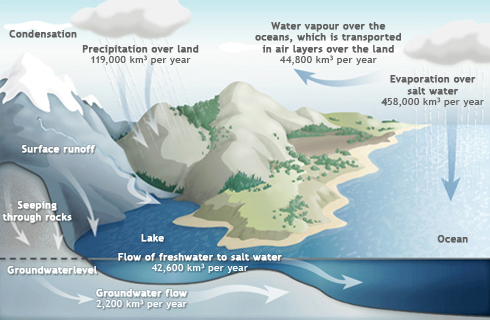
The volume of water is a constant. Approximately 1386 million cubic kilometres of water are permanently in motion. Through solar radiation, which converts liquid water into water vapour, it evaporates from the surface of land and water. Humidity stored in vegetation is also released into the air (evapotranspiration).
With increasing temperatures the air can absorb increasing quantities of water vapour, which is the basis of the water cycle.
The water vapour in the atmosphere condenses into drops of water. From these, clouds are formed and rain eventually falls. It is essential for our survival that part of the water that evaporates from the oceans falls on the land, feeds the rivers, waters the soil and fills up groundwater aquifers.
| Temperature | Storage capacity of water vapour in the air |
|---|---|
| 0 °C | 4,48 g/m³ |
| 10 °C | 9,4 g/m³ |
| 20 °C | 17,1 g/m³ |
| 30 °C | 30,4 g/m³ |
| 45 °C | 65 g/m³ |
Fact and Figures
Facts and Figures
An individual’s basic water needs
- A human being needs approximately 3 litres of water a day for drinking.
- Per capita consumption is approximately 130 litres - for drinking, taking a shower or a bath, cooking, washing clothes, washing dishes and for heating.
- On average, one human being consumes 625m³ of water annually.
- A human is made up of approximately 60% water.
- A human can survive for up to 40 days without food, but no longer than 4 days without water.
- According to the WHO (World Health Organisation), 5 million people die annually as a result of drinking contaminated water.
- In 25 years up to 6 billion people will suffer from poor hygiene because of a shortage of water.
In the global perspective
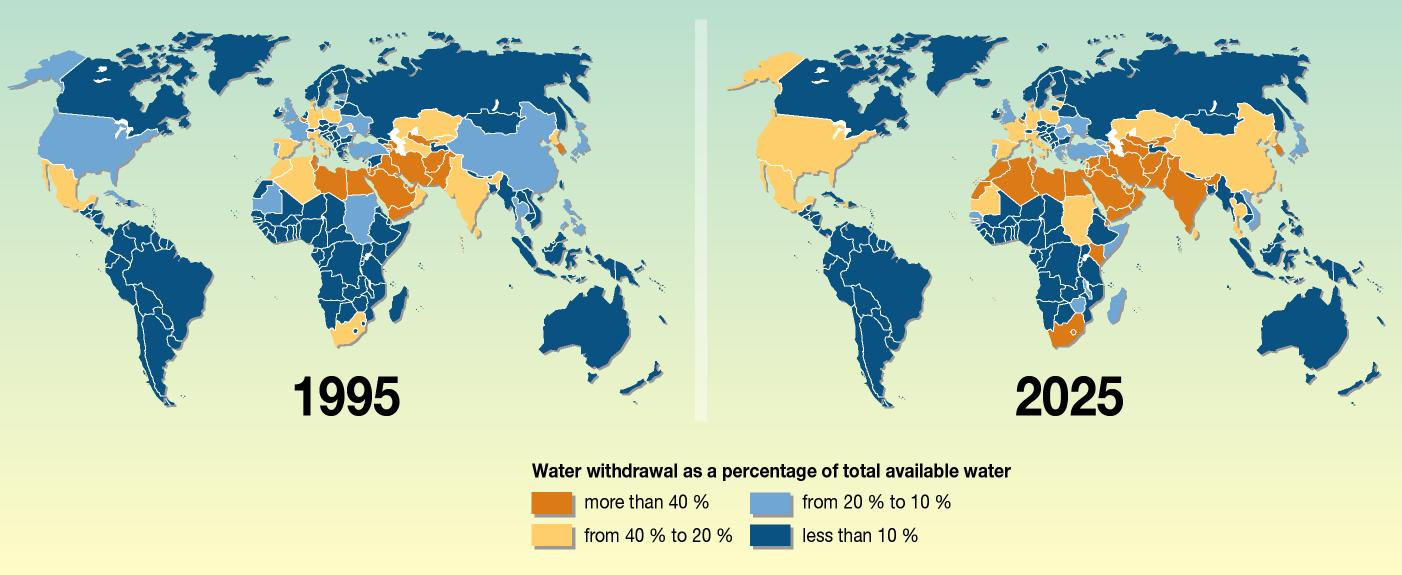
However, global water reserves are limited, added to which, according to UNO estimates, the world’s population is set to increase from approximately 6.6 billion today to 9.2 billion by 2050. Due to the increasing average per capita consumption of water, currently 625m³ per annum, water consumption will also grow disproportionately.
Globally, more than one billion people have no access to clean drinking water. In 25 years up to 6 billion people will be experiencing water shortages because of poor hygiene. Even Europe’s natural water resources are being put under ever-increasing stress. Water stress arises when the amount of water used exceeds availability. In Austria, only < 5% of the total renewable water supply is extracted annually – we therefore live in a veritable water paradise. By contrast, a growing number of countries is becoming partially or completely under water stress as illustrated below.
Virtual Water
Visualizing water
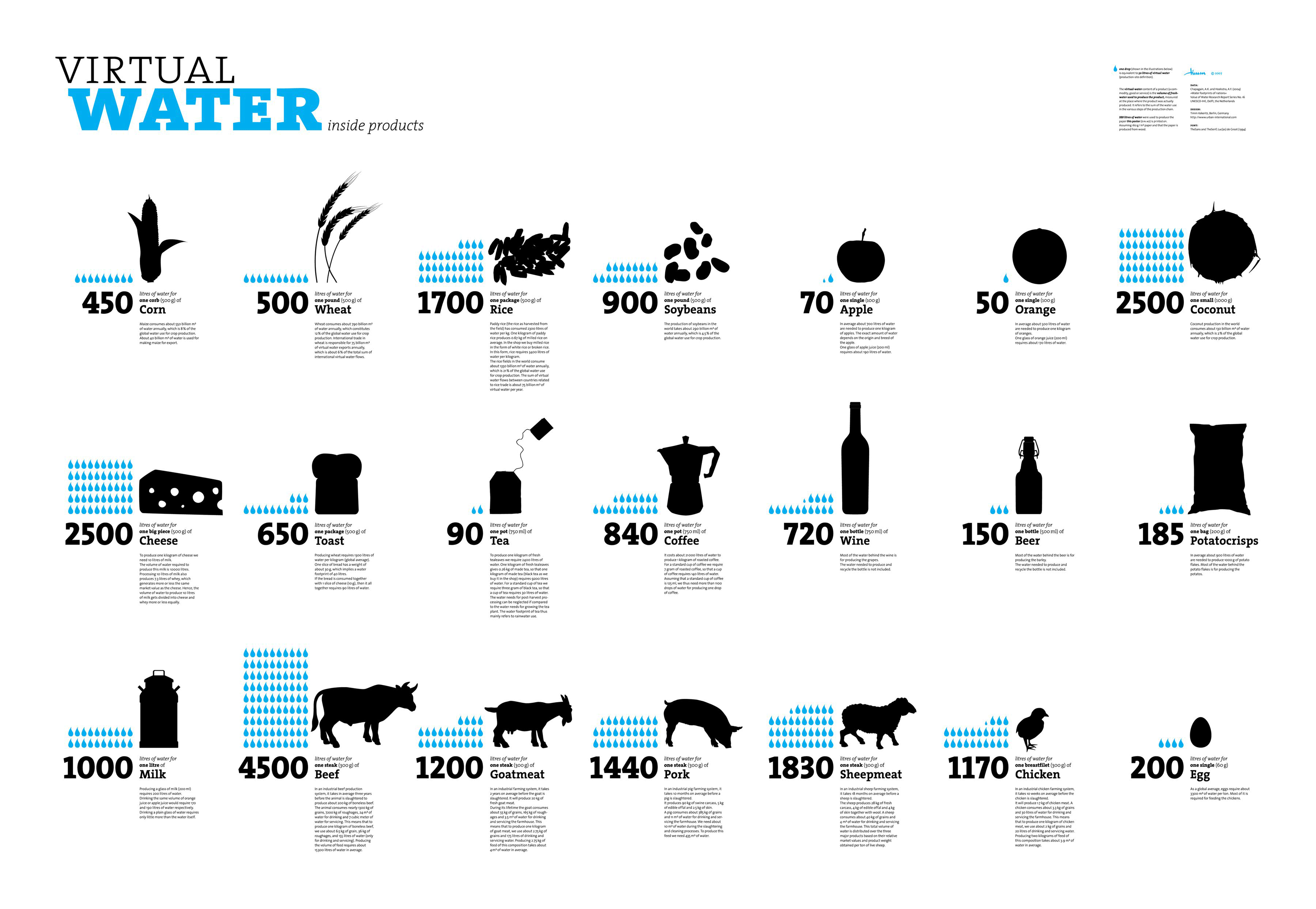
The ecologist, Anthony Allan, of London King’s College has developed the concept of 'virtual water' for the total quantity of used to manufacture a product.
In brief, it is the quantity of clean water that evaporates, is consumed or is contaminated during the production of a product - from the watering of commodity crops to the water used to cool the machinery used.
When the 'water footprint' of various products is calculated, it reveals a much higher consumption of water than might have been thought at first sight.
Water Global Market
Water global market
Riseing Water Demand
The demand for water will continue to rise considerably. Meanwhile, however, the availability of fresh water resources is diminishing owing to contamination, sinking groundwater levels, dried-up wells and climate change. Over the last 30 years water consumption in the USA has trebled, whereas the population has grown by only 50%. Global water consumption doubles every 20 years, more than twice as fast as population growth. Current trends suggest that, by 2025, a third of the population will have no access to clean drinking water.
The global world market is estimated by Goldman Sachs (2008) to be worth around 425 billion US dollars, with a long-term growth of 4%-6 %. In industrial markets an average growth of 3%-5 % (USA and Western Europe) is expected through an improvement in existing water and wastewater infrastructure within 5 to10 years, compared with 10% or more in developing markets (China and India) through the creation of a new water and wastewater infrastructure.
Owing to the substantial imbalance between supply and demand, the strongest growth areas in the global water market will come from high-end water treatment technologies, like membrane filtration and reverse osmosis desalination.
Membrane filtration eventually can lead to a considerable reduction in water treatment chemicals, such as chlorine.
Desalination
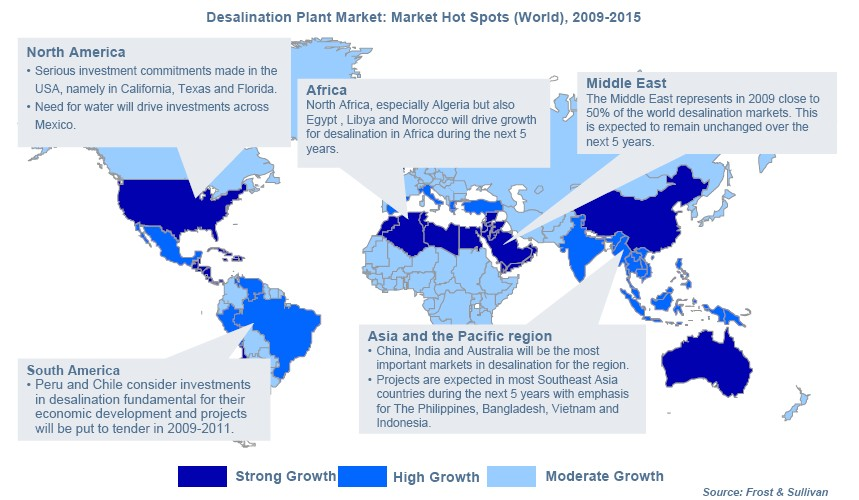
There are a growing number of countries where renewable water resources are not available or too costly in economic as well as in ecologic terms to make available, hence desalination of see water remains the one and only viable solution. A market overview is given below:
Of the more than 12,500 desalination plants in operation or in construction worldwide, 60 percent are located in the Middle East and North Africa (MENA).
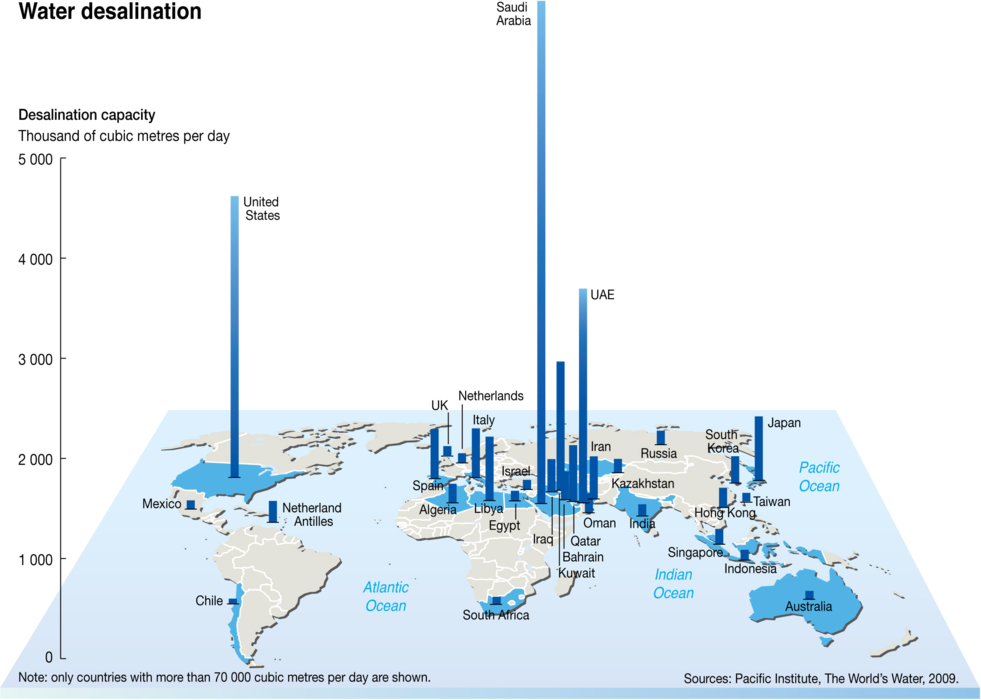
The above figure illustrates various countries’ usage of desalination.
Worldwide usage of water is expected to further grow with climate-induced water stress combined with population growth, industrialisation in developing countries and as desalination technology becomes cheaper due to higher efficiency, economy of scale for larger installations, etc.
Why It Matters
To understand water is to understand one of the deepest links between nature, technology and society. Every section of this journey points to the same conclusion: water knowledge is becoming essential for sustainable growth and long-term resilience.